Josiah McCruiston
25/26
Josiah Ray McCruiston is a multidisciplinary artist, director, and cultural architect whose work explores the intersections of Black identity, spirituality, and collective liberation. As the founder and CEO of Grand Griot Productions, he is committed to incubating new Afrocentric works that center cultural storytelling, artistic excellence, and community impact.
An award-winning actor and playwright, his work spans theatre, education, and museum performance, including collaborations with the Indiana Historical Society, Conner Prairie, Disney, and The Children’s Museum of Indianapolis. As the Department Chair of Performing Arts at Providence Cristo Rey High School, he cultivated brave spaces where young artists are empowered to create, reflect, and lead. As the curator of Afrocentric Approaches to Acting Aesthetics, Josiah equips artists with culturally rooted methodologies that honor resilience, identity, and truth. His work, supported by institutions such as the Lilly Endowment and the Joyce Foundation, continues the legacy of the Black Arts Movement while shaping the future of American theatre.
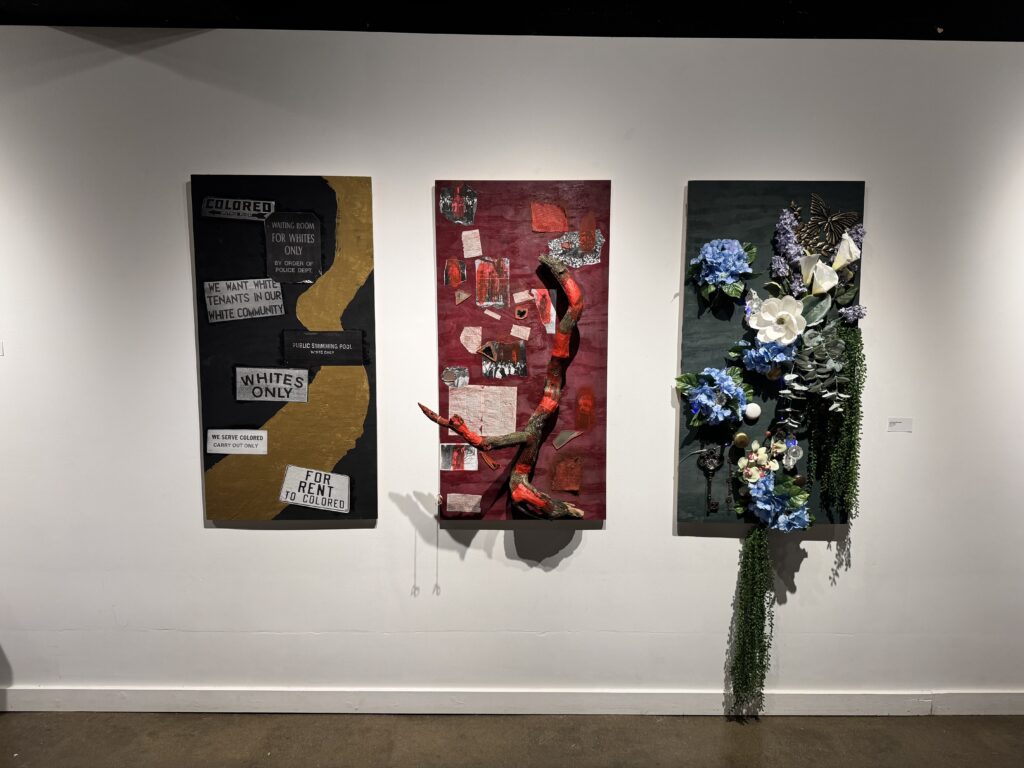
Folk Triptych | mixed media
“This triptych installation reimagines the Parable of the Good Samaritan as an Afrocentric folk narrative, unfolding through the sacred lens of the Trinity—Father, Son, and Holy Spirit—expressed through visual art, music, and performance. The work asks a simple but urgent question: Who has been allowed to be seen as “good,” and who has been denied that naming? Historically, this parable has often been framed through a white moral imagination, where goodness and saviorhood are implicitly tied to whiteness. This work disrupts that lens, situating the story within the lived and inherited realities of Black existence. The first movement, “The Black Code Road,” begins at the shore of the Great Migration. Here, the journey is obstructed not by terrain, but by legislation, signs, and systems that mark bodies as clean or unclean, worthy or unworthy. The Adinkra symbol Nkyinkyim (twisting) reflects the nonlinear, resilient path of survival. Paired with August Wilson’s Gem of the Ocean and Odetta’s “900 Miles,” this section asks: What if the road was never the danger, but the codes governing it were? The second movement, “Read All Over,” confronts the violence of neglect. The priest’s passing becomes a haunting parallel to America’s history of lynching, where the refusal to intervene becomes its own form of harm. The presence of mirrors implicates the viewer, asking them to see themselves within the story before turning away. The Adinkra symbol Gye Nyame (“except for God”) is carved as both lament and declaration, paired with “Strange Fruit,” holding tension between suffering and divine witness. The final movement, “The Doors of the Church (Are Now Open),” offers sanctuary. Inspired by the innkeeper’s refuge, this space becomes a living memory of home, care, and sacred welcome. Crystal doorknobs and heart-shaped Sankofa keys evoke return—go back and get what was lost. The audience is invited not only to see but to smell the flowers, engaging the fullness of the senses. Accompanied by selections from THIRST by C. A. Johnson and The Vagabond by Ralph Vaughan Williams, this movement calls us to embody the work of restoration. If one can see or hear the Trinity woven throughout this piece, that person is called into awareness, and from awareness, into action. Because the work of the Good Samaritan has never been passive. It requires attention. It requires interruption. It requires us.”